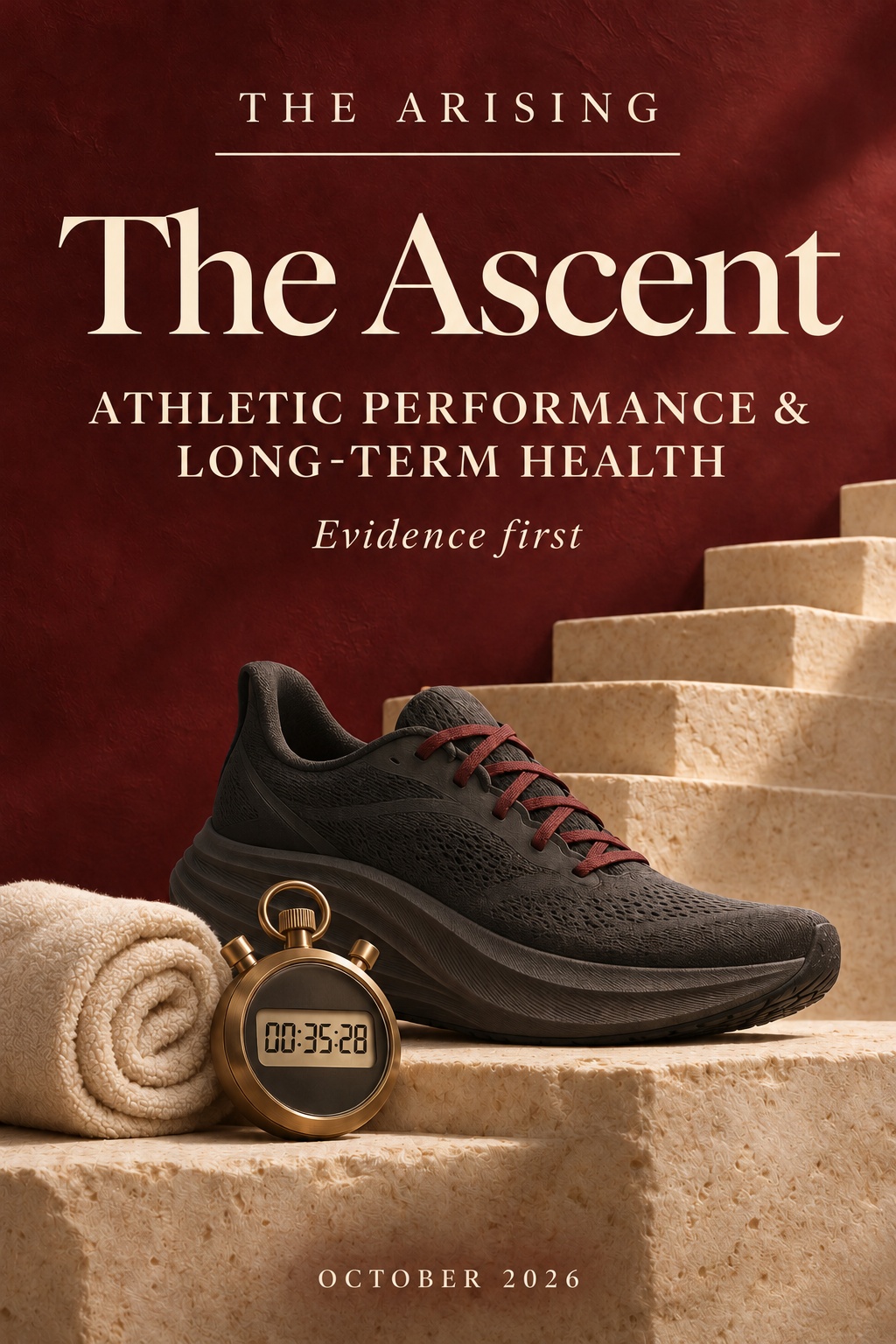
The long game is the real game.
Athletic performance is not only what you can do this season. It is what your body can still do in twenty years. This issue explores that long view through recovery, how the body uses and stores fuel, brain health, bone biology and the frontier of aging science.
HOW TO READ THE FINDINGS
Some studies compare treatments in groups assigned by chance. Others follow people’s existing habits, summarize earlier research, or investigate animals and cells. These methods answer different questions: a link between a habit and better health does not prove the habit caused the benefit. No source in this issue establishes that an intervention extends athletes’ lives or improves their competition results.
THE ROUTE
03 Recovery and the sleep signal
04 Fuel, liver fat and muscle
05 Biological age: what the clock really knows
06 Bones, NAD+ and the laboratory frontier
07 Brain health, teams and purpose
08-09 The training-science briefings
10 Markets, tools and what comes next
11 Questions for the next training block
12-14 Sources and further reading
When a nap is a signal, not a strategy
RECOVER WITH CONTEXT
OBSERVATIONAL • 995 OLDER ADULTS • ASSOCIATION, NOT CAUSATION
WHAT THE RESEARCH FOUND
Researchers followed 995 older US adults who did not have possible or probable dementia at the start. Frequent nappers had an estimated 48% higher rate of developing possible or probable dementia during follow-up (hazard ratio, or HR, 1.48; 95% confidence interval, or CI, 1.14–1.94). Unintentional napping was linked to an estimated 39% higher rate (HR 1.39; 95% CI 1.06–1.81). These are relative comparisons, not the percentage of nappers who developed dementia. The confidence intervals describe uncertainty around the estimates under the study’s assumptions: the first allows for a rate about 14% to 94% higher, the second about 6% to 81% higher. The study found a link; it did not show that naps caused dementia.
THE ATHLETE INTERPRETATION
For athletes, the relevant distinction is between planned recovery and unexplained sleepiness. This study did not enroll athletes, measure performance, or show that eliminating naps prevents dementia. Persistent unplanned daytime sleepiness can justify discussing sleep quality and potential medical causes with a clinician.
See source 01 below.
A plant-forward diet, less liver fat, and a big caveat
METABOLISM ≠ PERFORMANCE
25 PARTICIPANTS • ONE DIET GROUP • NO COMPARISON GROUP
WHAT THE RESEARCH FOUND
Twenty-five adults with type 2 diabetes began a 16-week low-fat vegan dietary intervention; 24 completed it. Average weight fell 6.0 kg, and the reported relative reduction in liver fat was 33%. Participants received dietary support, but there was no control group. Lean mass, meaning body mass other than fat, also fell by an average of 2.4 kg (95% CI 1.8–2.9 kg lost). That range describes uncertainty around the average loss, not the range of losses experienced by individual participants. The 33% liver-fat reduction is relative to the starting amount; it does not mean liver fat fell by 33 percentage points.
THE ATHLETE INTERPRETATION
The athletic question is not simply whether weight falls, but what happens to having enough fuel for exercise and everyday needs, training quality and tissue other than fat. This trial did not measure athletic performance and cannot separate dietary composition from reduced calorie intake and weight loss. Its measured lean-mass loss deserves attention, although lean mass is not the same as directly measured skeletal muscle.
See source 02 below.
Can an epigenetic clock measure the long game?
MEASURE WHAT MATTERS
OBSERVATIONAL • 894 DOGS • NOT HUMAN VALIDATION
WHAT THE RESEARCH FOUND
A Science study examined 1,640 profiles of chemical marks on DNA from 894 dogs. These marks, called DNA methylation, can change with age. Researchers used their patterns to build an “epigenetic clock,” a calculated estimate of aging. Its readings were linked to the risk of death and suggested faster molecular aging in larger and male dogs.
THE ATHLETE INTERPRETATION
Biological-age measurements are intriguing, but a group-level relationship with mortality does not validate an individual athlete’s score, and this dog study does not show that changing a clock changes health outcomes in humans. Performance tests and clinical outcomes remain different questions.
See source 03 below.
Old bone marrow, NAD+ and the limits of supplements
MECHANISM ≠ MEDICINE
PRECLINICAL • ANIMAL/LAB MODELS • NO HUMAN BENEFIT SHOWN
WHAT THE RESEARCH FOUND
A laboratory study explored why aging bone marrow may become less able to support new bone. Fat cells and immune cells called macrophages sent inflammatory signals that increased the activity of an enzyme, CD38. This reduced the NMN available to nearby bone-forming cells. NMN helps cells make NAD+, a molecule needed for many cell functions. In mice, researchers reduced bone loss by combining NMN with treatment that blocked an immune-signaling pathway called STING.
THE ATHLETE INTERPRETATION
This is a mechanism worth following, not an athlete-ready recovery or bone-health protocol. The study did not establish benefit in people or an effective human supplement dose. It did not test each treatment on its own, so it cannot establish whether the combination outperforms either component alone.
See source 04 below.
The protective potential of showing up for others
BELONGING IS PART OF HEALTH
OBSERVATIONAL • 17,972 ADULTS • OTHER DIFFERENCES MAY HELP EXPLAIN THE LINK
WHAT THE RESEARCH FOUND
An observational analysis of 17,972 adults from the Health and Retirement Study associated sustained formal volunteering with a slower decline in thinking and memory among people carrying APOE ε4, a gene variant linked to increased Alzheimer’s risk. The association appeared even at modest commitments, up to four hours weekly. These broad annual-hours categories do not establish an effective weekly dose.
THE ATHLETE INTERPRETATION
Sport is also community. Coaching, mentoring and belonging may be worthwhile independent of any biological effect. But this study did not test athletes, assign people to volunteer, or prove that helping prevents Alzheimer’s disease.
See source 05 below.
The science beneath the training.
The following studies explore questions beneath the headlines. They are not a ranked list of interventions for athletes; who took part and what was tested matter.
SLEEP & CIRCADIAN / Irregular sleep rhythms and mortality
Wrist-worn activity data from 3,061 US adults with cardiovascular-kidney-metabolic syndrome, a group of linked heart, kidney and metabolic problems, linked fragmented daily rhythms and variable sleep timing to a higher risk of death from any cause. Observational; not an athlete trial.
Sleep Health (2026-10-09) Source 06.
SLEEP & CIRCADIAN / Cannabis for sleep: evidence remains limited
A journal commentary found limited evidence for sleep benefit or safety among adults over 50; most experiments involved younger adults. This is an evidence discussion, not a systematic review or a positive intervention trial.
Journal of Cannabis Research (2026-10-09) Source 07.
METABOLIC BIOLOGY / Exercise and protein lactylation
A review explored how lactate, a substance produced as the body uses fuel, might help carry exercise-related signals. It focused on lactylation, the addition of lactate-derived chemical marks to proteins, and possible changes in how cells use energy. It brought together ideas about cell processes rather than reporting a new trial in people.
Molecular Medicine Reports (2026; December issue). Source 08.
Signals worth watching.
METABOLIC BIOLOGY / Autophagy and liver glucose in mice
Blocking autophagy, the cell’s system for breaking down and recycling its own material, reduced the liver’s production of sugar in mouse experiments. The protein Foxo1 played a role. This does not establish a useful training or nutrition strategy for people.
Diabetes, Obesity & Metabolism (2026-10-09) Source 09.
METABOLIC BIOLOGY / Intermittent fasting and liver lesions in rats
Intermittent fasting reduced early abnormal areas in the liver in a rat model of cancer. These data cannot establish human cancer prevention or an athletic fasting protocol.
Journal of Histochemistry & Cytochemistry (2026-10-08) Source 10.
SLEEP & TECHNOLOGY / Sleep ECGs and long-term cardiovascular risk
An AI model used ECGs, recordings of the heart’s electrical activity, collected during sleep studies. Its predictions were linked to later heart and blood-vessel problems in groups of hospital patients. That does not yet show that using the model leads to better care.
Sleep (2026-10-09) Source 11.
The business of staying capable.
A tablet targeting the GLP-1 system moves toward Europe
On October 15, a committee of the European Medicines Agency (EMA) issued a positive opinion for Lilly’s orforglipron, pending a European Commission decision. The drug acts on GLP-1 receptors, part of the body’s system for regulating blood sugar and appetite. Relevance to athletes: metabolic treatment access and questions about body composition, not evidence of performance enhancement. Source 12.
AI drug discovery advances
BioAge and Deep Origin reported compounds that showed the desired activity in early laboratory tests in a collaboration targeting aging-related cardiometabolic disease. Finding these “hits” is an early step in drug discovery, not a proven therapy. This is a company-reported milestone. Source 13.
Whole-body scanning arrives in the US
Neko Health announced its New York opening on September 24, with more than 25,000 local people on its waiting list. Screening enthusiasm should be separated from demonstrated improvement in patient outcomes. Source 14.
Tau-silencing: promising biomarker, uncertain benefit
Arrowhead reported early reductions in tau, a protein measured in the fluid surrounding the brain and spinal cord, in healthy volunteers in its October 14 interim announcement. This is a company-reported change in a biological measurement, not evidence of improved cognition or athletic performance. Source 15.
Train for the decades, not just the day.
The athlete edition has one organizing principle: distinguish a biological signal from a proven intervention. Today’s reporting offers useful questions about sleep, nutrition, aging biomarkers, bone biology and social connection. It does not provide a new validated performance program.
QUESTIONS TO CARRY INTO YOUR NEXT TRAINING BLOCK
• Is my daytime sleepiness planned recovery, or a new unexplained change?
• Am I evaluating nutrition by performance and lean mass, not scale weight alone?
• Does a biological-age number predict anything meaningful for me?
• Am I treating supplement findings from animals and cells as ideas to test rather than instructions to follow?
• Does my sport connect me with people, purpose and a longer horizon?
MEDICAL NOTE
This is general education, not personalized medical advice. Consult an appropriate clinician before changing treatments or medication.
Sources and further reading
Exact sources for the principal features. Links open the primary record.
01 / Napping
Jiang K et al. Napping characteristics and incident dementia: results from the National Health and Aging Trends Study. J Gerontol A. 2026;81(10):glag208. DOI 10.1093/gerona/glag208. No athlete outcomes.
02 / Low-fat vegan diet
Kahleova H et al. Changes in ectopic lipids, insulin sensitivity, and beta cell function after a low-fat vegan diet in adults with type 2 diabetes: a 16-week single-arm clinical trial. BMJ Open Diabetes Res Care. 2026;14:e006472. DOI 10.1136/bmjdrc-2026-006472. No comparison group.
03 / Dog epigenetic clock
Mariner BL et al. Epigenetic aging and transposon dysregulation reflect size-related lifespan compression in dogs. Science. 2026;394:eaeb2986. DOI 10.1126/science.aeb2986. Not tested as a measure of human health.
04 / Bone marrow
Li Z et al. Bone Marrow Macrophage STING Signaling is a Direct Nexus Linking Marrow Adipose Expansion to NAD+ Depletion and Osteogenic Decline in Skeletal Aging. Advanced Science. 2026:e77571. DOI 10.1002/advs.77571. Neither treatment was tested alone.
05 / Volunteering
Han SH, Faul JD. Prosocial helping behaviors attenuate accelerated cognitive decline driven by APOE ε4. Alzheimer’s & Dementia. 2026;22:e71877. DOI 10.1002/alz.71877. Observed existing habits; did not test a prescribed amount of volunteering.
Sources, continued
06 / Rest-activity rhythms
Huang M et al. Rest-activity rhythms, sleep dimensions, and mortality in adults with cardiovascular-kidney-metabolic syndrome. Sleep Health. 2026 Oct 9. DOI 10.1016/j.sleh.2026.09.009. 3,061 participants.
07 / Cannabis and sleep
Draghmeh K et al. Cannabis for sleep in older adults: use has outpaced the science. J Cannabis Res. 2026;8:104. DOI 10.1186/s42238-026-00515-8. Journal commentary, classified as a Letter.
08 / Exercise and lactylation
Wang J, Wu L. Lactylation and exercise: A molecular link to disease alleviation (Review). Mol Med Rep. 2026;34:324. DOI 10.3892/mmr.2026.14035. Review of cell processes, not a new clinical trial.
09 / Autophagy and glucose
Shen Z et al. Autophagy Regulates Foxo1 Protein Abundance to Control Hepatic Glucose Production in Glucagon Signalling. Diabetes Obes Metab. 2026 Oct 9. DOI 10.1111/dom.71413. Mice and isolated mouse liver cells.
10 / Fasting and liver lesions
Comanzo CG et al. Controlled Extension of the Tumor Promotion Period Enhances Progression of GSTP-Positive Hepatocellular Lesions in a Rat Model of Hepatocarcinogenesis. J Histochem Cytochem. 2026 Oct 8. DOI 10.1369/00221554261479389. Early changes that can precede cancer in rats, not evidence of human cancer prevention.
Sources, continued
11 / Sleep ECG prediction
Prediction of cardiovascular outcomes using electrocardiography from overnight polysomnography. Sleep. 2026. DOI 10.1093/sleep/zsag229. Prediction in groups of hospital patients.
12 / Orforglipron
European Medicines Agency. Foundayo: CHMP positive opinion, adopted October 15, 2026. A favorable opinion is not Commission authorization.
13 / AI drug discovery
Deep Origin. Multi-target AI-driven drug discovery collaboration with BioAge Labs; validated hits confirmed against first target. October 14, 2026. Company announcement, not independent clinical evidence.
14 / Neko US opening
Neko Health. Neko Health opens its doors in New York. September 24, 2026. Company announcement of opening and waiting list only.
15 / Tau silencing
Arrowhead Pharmaceuticals. ARO-MAPT interim Phase 1/2a clinical data in healthy volunteers. October 14, 2026. Company report of a biological measurement, not demonstrated health benefit.
Industry announcements describe what companies reported, not proof that a product improves health.