1 NOVEMBER 2026 · LIGHT & SLEEP · UPDATED WITH 2026 RESEARCH
The clock changed. Your body follows the light.
What newer research says about daylight, sleep, cortisol and the health of the heart.
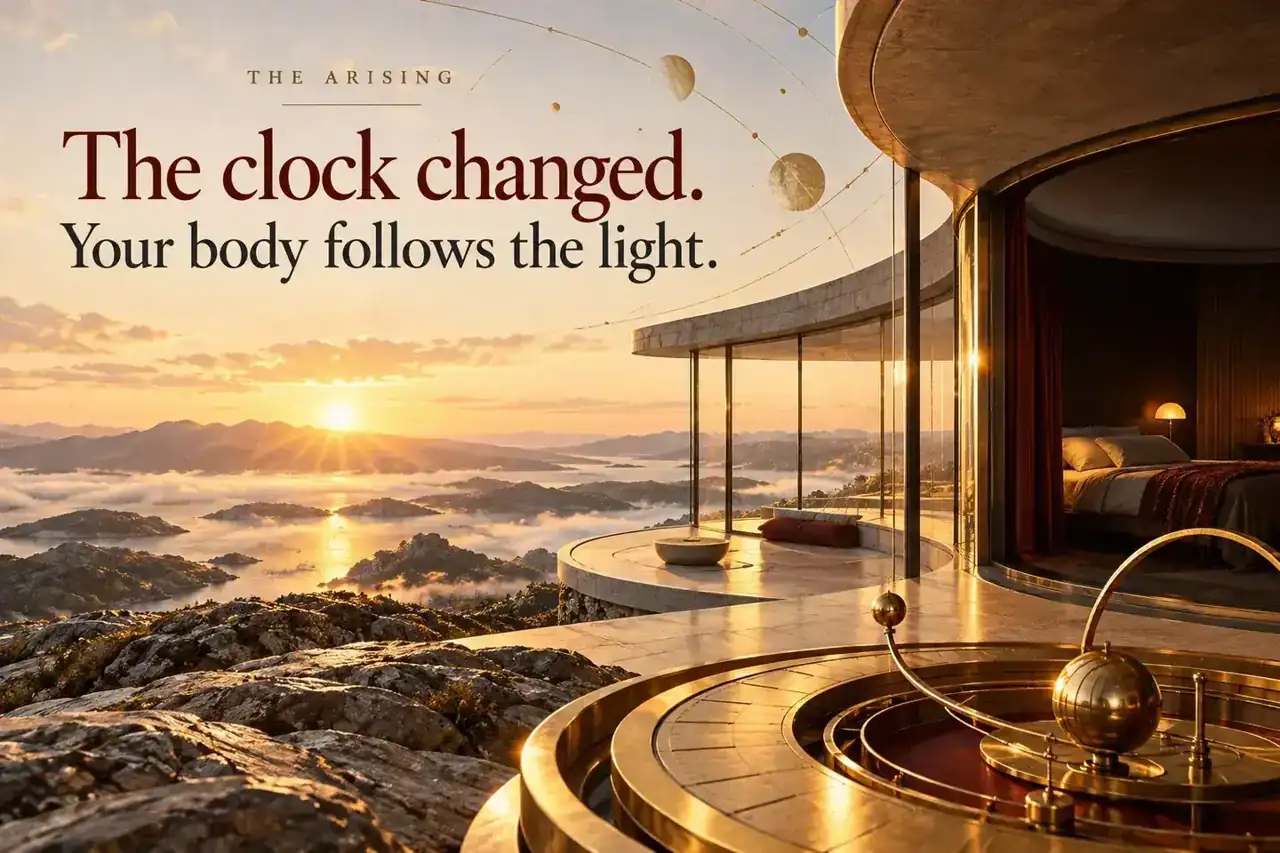
At 2 a.m. on November 1, 2026, clocks returned to 1 a.m. in U.S. places that observe daylight saving time. Missouri and Chicago are back on Central Standard Time. We changed the label on the hour; we did not add daylight to the day. [1]
A body does not update as instantly as a phone. Light helps set its daily timing. But how much does changing our light environment actually improve sleep? Research published in 2026 makes that question more interesting, and more specific.
2026: measuring light in ordinary life
A July 10, 2026 study followed 89 adults in Manchester with wrist-worn light sensors, Fitbit sleep trackers and diaries. More stable light patterns across the week, and brighter daytime exposure, were associated with earlier sleep timing. Some light measures were also associated with a greater proportion of wearable-estimated deep sleep early in the night. [2]
This is a useful move beyond laboratory lighting. It is also observational: people who sleep earlier may arrange their days differently. Wrist sensors do not measure exactly what reaches the eyes, and consumer sleep staging is not a laboratory EEG. The study cannot tell us that adding a certain number of minutes outside will produce more deep sleep. Data were collected in 2022–2024; the paper is new, not the measurements.
September 2026: a careful test in older adults
The CleverLights crossover trial compared two three-day laboratory lighting conditions in 12 older adults with self-reported poor sleep. One provided more blue-enriched light by day and greater blue-light reduction before bed; the other used standard lighting. Sleep was measured with polysomnography. [3]
The main outcome, time awake after initially falling asleep, did not significantly improve: 136 versus 117 minutes in the intervention and control conditions, respectively (p = 0.338). Exploratory brain-wave changes are interesting, but they do not overturn that result. With only 12 people and short exposure, this trial cannot rule out smaller or longer-term benefits. It does challenge the promise that changing light alone will reliably fix sleep.
2026: insomnia, daytime sleepiness and cortisol
A randomized pilot study published online June 4, 2026, and in the October journal issue enrolled 42 adults with insomnia. Both groups received cognitive behavioural therapy for insomnia, or CBT-I. One also used morning bright light; the other used a much dimmer placebo lamp. Treatment lasted about a month on average. [4]
Adding bright light did not significantly improve the primary outcome, insomnia severity, compared with placebo light. An exploratory follow-up measure favoured light for daytime sleepiness, which deserves further study. It is not the same as a proven improvement in insomnia.
The researchers also measured the cortisol awakening response. They found no significant added effect of light on that response. This is a direct connection to our cortisol and stress guide: a plausible mechanism is something to test, not a reason to promise a “cortisol reset.” The small sample, variable treatment duration and unmeasured background light exposure limit certainty.
2025: the heart-health connection is worth following
A study published October 23, 2025 linked one week of personal light measurements from 88,905 UK Biobank participants to subsequent cardiovascular records. Brighter nights were associated with higher rates of several cardiovascular diseases. For heart failure, the brightest-night group had an adjusted hazard ratio of 1.56 (95% CI 1.34–1.81) compared with the darkest half. [5]
That is an association, not evidence that darkening a bedroom will reduce an individual's risk by 56%. A single week may poorly represent years of exposure; residual confounding and reverse causation remain possible. The cohort was predominantly White and healthier than the general population. Measurements began in 2013–2016 and outcomes were followed through 2022. Long-term prevention trials are still needed.
What belongs in an ordinary day?
The practical starting point remains modest: for people who sleep at night, make room for daylight, keep sleep and wake times reasonably consistent, and let the evening become dimmer. A dark, comfortable, quiet sleeping space is sensible general sleep guidance. These newer studies do not establish a universal light-therapy dose or replace treatment for persistent insomnia or sleep apnea. [6]
Timing matters. If you are waking much earlier than intended, bright light at that very early hour may move your timing earlier still. Shift work and persistent sleep-timing problems call for advice matched to the schedule. Do not look directly at the sun. [7]
The older study belongs in the background
The 2013 camping experiment remains a useful illustration: eight adults shifted their melatonin rhythms earlier after a week outdoors, without a significant improvement in sleep duration or efficiency. It was a fixed-order summer experiment, not a trial of the November clock change. The current reading now leads with 2026 evidence rather than asking that small historical study to carry the story. [8]
Follow the question into the sleep collection
Our earlier articles, Modern life is changing the shape of sleep and Can the light at home help the aging brain?, remain part of this collection. Continue through light and daily rhythms, cortisol, sleep and dementia, and sleep apnea. Those are connected questions, not interchangeable diagnoses. None of the studies reviewed here establishes dementia prevention or lifespan extension.
Go deeper with The Arising
Complete sleep magazine · Sleep collection · Arising Health website · Public Atlas
All magazines · Listen & watch
Alive. Awake. Aware. · John Griffin, MD
Sources and review scope
[1] NIST: daylight saving time rules for 2026. Calendar event: November 1, 2026.
[2] Akgun et al. Light exposure and sleep architecture in real-world settings. July 10, 2026. DOI 10.1038/s44323-026-00087-z. Main text, methods and disclosures reviewed; separate supplement not reviewed. Funding includes Wellcome and investigator-initiated Signify/Philips Lighting support; related author interests were disclosed.
[3] Pun et al. The CleverLights Study. September 2, 2026. DOI 10.1111/jsr.70447. PubMed abstract and accessible publisher methods/conclusion extracts reviewed; complete tables, supplements, harms and disclosures not independently reviewed. Registered trial identifier reported by authors: ACTRN12619000138189.
[4] Schmid et al. Lights On or Off? Light therapy as an add-on to CBT-I. Online June 4, 2026; October 2026 issue. DOI 10.1111/jsr.70357. Main text, results table and disclosures reviewed. EUCOR funded the study; SNSF supported one author. Disclosed outside interests include speaking fees and sleep/light-related commercial honoraria. Recruitment: October 2022–December 2024.
[5] Windred et al. Light Exposure at Night and Cardiovascular Disease Incidence. October 23, 2025. DOI 10.1001/jamanetworkopen.2025.39031. Main text reviewed; supplements not independently reviewed. NIH support is indexed. Disclosed outside interests include Lilly consultancy, GSK stock and academic consulting.
[6] NHLBI: healthy sleep habits. [7] NIOSH: light and circadian rhythms, archived educational guidance. Both checked November 1, 2026.
[8] Wright et al. Entrainment of the human circadian clock to the natural light-dark cycle. August 19, 2013. DOI 10.1016/j.cub.2013.06.039. Historical context; main text and methods reviewed earlier in this edition.