Life Arises
A personal essay on change, understanding, and human possibility.
The Arising · John Griffin, MD · November 2026
Opening personal essay
A verb
Life arose.
The sentence sounds complete, as though it describes an event safely behind us. But the tense leaves something out.
Life arises. A person encounters the world and becomes able to do something they could not do before. An understanding changes. A relationship begins. A possibility appears that no one in the room had seen until someone asked a different question.
Not every change is an improvement. Not every beginning lasts. The point is to stop treating what exists now as a finished account of what can exist.
Understanding can remain open
Sometimes it is hard even to formulate the questions. What is this life? What can be known? What makes something matter? The questions can remain large without making the ordinary world inaccessible.
We can still see the person before us. We can still learn something true. We can still observe the effect of a choice and revise the choice when the evidence asks us to.
Understanding does not have to be final to be real. It can be precise about what has been seen and humble about what has not. That is an important discipline for medicine. It is also a way of remaining available to life.
We see a possibility on the horizon, or in orbit. We encounter it in the consideration of a new idea, or in the eyes of those who live around us. A life is occurring, and we are participating in it before we have found all the words.
Looking up together
The photograph is still in my office. The paper-framed glasses are still nearby. The mug continues to ask its question.
Where will you be?
The people in the photograph were together beneath the eclipse. The date has passed. What it means has continued to change.
What remains in the photograph is not simply an astronomical event. It is the company in which we encountered it. People whose ordinary days were intertwined stood together beneath a sky that made us beginners again.
There are reasons to want more life that no number can adequately describe. This was one of them.
More room for one another
More years would give us more chances to meet a changing world. Better health could make some of those encounters more possible. Better care could help us remain in them when health fails. Better understanding could show us a path we had not known to look for.
I want more years, yes. But I want more than years.
I want more opportunities for life to unfold, in all the ways a human life can be fully lived. More room to become. More room for one another.
This is an essay about meaning, not a scientific account of the origin of life or a prediction that technological progress is inevitable. The wonder belongs to reality as we can meet it, with our questions still open.
There is this true thing, and it is a verb.
We are in the midst of it now.
A life still unfolding
An editorial companion on meaning, awe, participation, and human possibility.
Meaning has more than one question
A wish for more life carries a question inside it: more life for what? The answer need not be a grand undertaking. It might be time to understand a difficult subject, to care for someone, to finish a conversation, or to be present when something ordinary becomes precious. A future can matter before we know its exact contents.
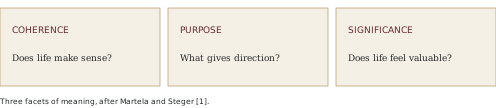
In a 2016 conceptual paper, Frank Martela and Michael Steger distinguished three facets of meaning: coherence, the sense that life makes sense; purpose, having direction and aims; and significance, the sense that life has value. This is a way of clarifying a difficult subject, not a clinical test or a recipe that everyone must follow. [1]
Consider an imagined person leaving a long-held role. The calendar may suddenly feel empty even though the person remains loved. Another person may be busy with urgent tasks while struggling to understand why those tasks deserve so much of life. The distinction helps us ask more carefully what is missing. Neither example implies that a person needs to earn the right to matter.
The opening essay places company beside wonder. Its photograph holds an event and the people who shared it. Here, meaning is not confined to an achievement or a destination. It can belong to an encounter whose importance becomes clearer afterward. A person may return to the same object and find a different question waiting there.
That possibility should make us cautious about demanding a finished life story from ourselves. Some experiences resist explanation. Loss need not be justified by a lesson. Uncertainty need not be tidied into a reassuring conclusion. There can be care, loyalty, and attention within a life that does not yet make sense.
A useful question, then, is specific enough to live with: what deserves a little more room this week? The answer might concern direction, understanding, or a relationship. It may be modest. It may change. Choosing something worth tending is an act available before a final account of meaning arrives.
Awe without a promise
An eclipse offers an unusually clear image of interrupted expectation. Familiar daylight changes; looking becomes an event. Yet the importance of an encounter cannot be read from its scale alone. A vast scene may leave one person unmoved. A small detail may open another person's attention. The experience belongs to the meeting between a world and someone able to notice it.
Dacher Keltner and Jonathan Haidt's 2003 theoretical account proposed two central features of awe: perceived vastness and a need to revise existing mental frameworks. Their account also allowed for different emotional tones, including threat. Awe should not be reduced to compulsory happiness. [2]
A small randomized study offers a narrower empirical foothold. Sixty healthy older adults took weekly 15-minute outdoor walks for eight weeks, with or without instructions encouraging awe. Those assigned awe-oriented walks reported more awe, joy, and prosocial positive emotions during walks. Some daily emotional measures also improved. Anxiety, depression, and life satisfaction did not change from baseline in either group. Published online in 2020 and in an August 2022 journal issue, the study examined emotional experience, not lifespan extension. [3]
The distinction matters. An interesting result can invite further investigation without becoming a health guarantee. A brief study in healthy older volunteers cannot establish that awe prevents disease, treats depression, or adds years to life. Nor does it establish that every way of seeking wonder will have the same effects. A meaningful experience needs no invented medical benefit to deserve a place in life.
There is also freedom in leaving an encounter unscored. A person can spend time with music, a landscape, an intricate object, or a question without asking whether the experience has improved a biomarker. For some, that attention will be moving. For others it will be quiet or uneventful. No response needs to be forced.
The practical invitation here is editorial, not a prescribed intervention: notice something with enough patience to let it be more than its first description. Choose a setting that is accessible and comfortable. Stay curious about the experience, including the possibility that nothing remarkable happens. Wonder is an invitation, not an obligation.
A place to participate
Human possibility is easy to describe at a distance. Closer to daily life, it asks for time, tools, access, and other people. A new idea becomes consequential when someone can try it. A relationship needs occasions for contact. A wish to learn needs an entry point that does not require already knowing everything.
Participation can begin on a scale smaller than ambition. An unanswered question can become a conversation. A confusing subject can become one page read carefully. An intention to reconnect can become an invitation that allows the other person to decline. None of these examples promises transformation. Each creates a real next step whose outcome can be observed.
This is one way to distinguish possibility from prediction. Possibility leaves room for effort and uncertainty. Prediction makes a claim about what will happen. The statement that a fuller life can be imagined does not show that technology will deliver it, or that a particular person will receive more healthy years. The opening essay's wish for more room can stand without either assurance.
Participation also has conditions. Money, disability, geography, caring responsibilities, and the design of shared spaces can make an invitation easy or difficult to accept. An account of flourishing that speaks only about personal attitude overlooks those conditions. Asking what someone needs in order to join may be more useful than telling them to be more engaged.
There are days when participation means receiving care. There are forms of contribution that produce no public achievement: listening, remembering, making another person's work possible. A person who cannot contribute in a familiar way has not become less worthy of attention. Human value is a poor subject for a productivity score.
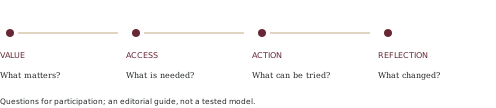
The diagram below is a set of questions for a chosen activity, not a validated model. Start with something that matters; ask what makes it accessible; try a proportionate step; notice the result. Stopping or changing direction remains an acceptable answer. Possibility becomes more honest when it includes limits, rest, and the freedom to say no.
Changing our understanding
To remain open is not to accept every explanation. It is to be willing to distinguish what happened from what we first made of it. The opening essay describes a photograph whose date is fixed while its meaning continues to change. The event does not have to be rewritten for the understanding to deepen.
This distinction is useful whenever a powerful experience meets a claim. A person may feel renewed after an encounter with beauty. That feeling is real as an experience. Explaining it as a particular biological mechanism, or promising the same result to someone else, requires different evidence. Respect for the experience and care with the explanation belong together.
A thoughtful response can proceed in three movements. Describe what was noticed. Consider more than one interpretation. Ask what observation would change the preferred interpretation. These are editorial habits of inquiry, not a psychological treatment. They help keep a strong impression from becoming an unquestionable conclusion.
Imagine a group leaving a shared event. One person speaks of belonging, another of discomfort, another of surprise. Listening does not require dissolving those differences into one story. It may instead reveal how much remained unseen from a single position. A shared world need not produce identical experiences.
The same openness can turn toward plans. Something once pursued may cease to deserve its place. Something neglected may become important. Revision can be an expression of fidelity to what matters now, rather than evidence that the earlier life was wasted. We can honor an earlier commitment while recognizing that its next form will be different.
This is a modest account of human possibility. It does not require inevitable progress or an unlimited future. It asks whether the next available action can make room for understanding, care, or participation. A difficult condition may remain difficult. The act can still matter within it.
The wish for more years and the wish to live those years fully belong in conversation. Health may expand what is possible; care matters when health cannot be restored. Meaning is not a substitute for either. The unfinished quality of a life gives us questions to keep asking, and people with whom to ask them.
Sources and further reading
Martela F, Steger MF. The three meanings of meaning in life: Distinguishing coherence, purpose, and significance. The Journal of Positive Psychology. 2016;11(5):531-545. Conceptual analysis. Author-affiliated research record · DOI.
Keltner D, Haidt J. Approaching awe, a moral, spiritual, and aesthetic emotion. Cognition and Emotion. 2003;17(2):297-314. Theoretical account. PubMed record and abstract · DOI.
Sturm VE, et al. Big smile, small self: Awe walks promote prosocial positive emotions in older adults. Emotion. 2022;22(5):1044-1058. First published online September 21, 2020. Randomized study, 60 healthy older adults, eight weeks. PubMed record and abstract · DOI.
Reading the boundaries
The opening personal essay and the companion's reflections concern values, experience, and choices. They are not medical advice. The two conceptual papers offer ways to understand meaning and awe; they do not test longevity interventions. The randomized walking study addresses short-term emotional outcomes in its study population. It does not establish disease prevention or longer life.
The examples in the companion are illustrative, not patient histories or additional memories of the author. The questions and diagrams are invitations to reflection, not diagnostic scales or validated care programs. No level of purpose, positivity, or awe is a condition of a person's worth.