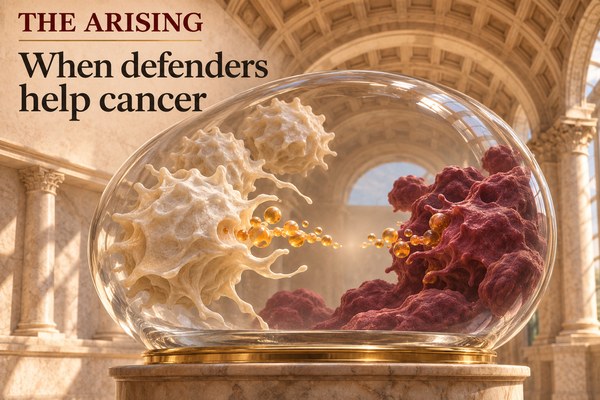
Some immune cells surrounding a tumor can become part of the cancer’s support system. A new study reports that senescent T cells release signals rich in lipids that change how tumor cells behave, helping them grow, spread, and resist chemotherapy in experimental models. When researchers removed those T cells or disrupted the metabolic changes they induced, tumor progression and spread were suppressed.
The striking idea is that a defender can become more than ineffective. Its altered behavior can actively help the disease it would otherwise be expected to oppose. For cancer treatment, that opens a different question: could we improve the response by interrupting a harmful conversation happening around the tumor?
The paper, published November 6 in Cell Reports Medicine, connects two major areas of aging research—cellular senescence and cancer biology. These treatment experiments were preclinical, so they identify a therapeutic strategy rather than a demonstrated benefit for patients.
The neighborhood matters
A tumor is not an isolated mass of malignant cells. It develops among immune cells, structural cells, blood vessels, and the molecules they exchange. That surrounding environment can change the conditions under which cancer survives. Understanding the neighborhood can therefore reveal opportunities that a cancer-cell-only view would miss.
T cells are central participants in immune defense. Yet the label tells only part of the story. Their state matters: what signals they receive, what programs they activate, and what they send back into the tissue around them. In this study, researchers focused on a dysfunctional state called senescence.
Cellular senescence is not a synonym for a person’s birthday. It describes a change in cell state, including altered activity and secretion. A senescent cell can remain biologically influential. The fact that a cell is no longer behaving as a vigorous defender does not mean it has become silent.
This is why the finding belongs in aging science without becoming a claim that older people’s immune systems inevitably support cancer. The meaningful unit is the particular cell, in a particular condition, within a particular tissue environment.
From a cellular signal to cancer behavior
The investigators began with single-cell analyses identifying senescent T cells across breast, colorectal, and lung cancers. That approach examines the programs active in individual cells rather than averaging all the cells in a tumor into a single signal.
The experimental work then addressed a more demanding question: could those T cells change cancer-cell behavior directly? The reported answer was yes. Their secretions were enriched in lipids, and those secretions altered tumor-cell metabolism and activated signaling involving STAT1 and STAT3. In the models studied, the downstream effects included greater tumor growth, metastasis, stem-like behavior, and resistance to chemotherapy.
The exact protein names are less important than the relationship they reveal. One cell’s condition changed what it released. Those released molecules changed the operating conditions of another cell. The result was a tumor better equipped to persist.
Chemotherapy resistance makes this especially consequential. A treatment does not act in an empty dish or a static tissue. The environment around a cancer may help determine how the cancer responds to the pressure of treatment. If a harmful signal is sustaining that resistance, blocking it could become part of a combination strategy.
Interrupt the help, preserve the defense
The researchers tested two broad ways of interfering with the process: depleting the senescent T cells and disrupting the tumor’s lipid metabolic reprogramming. Both suppressed the senescent-cell-driven progression and metastasis in the experimental setting. That moves the work beyond a catalog of cells found near cancer; it connects an intervention to a change in the model’s behavior.
The clinical challenge would be selectivity. T cells have essential defensive jobs. Removing them indiscriminately would miss the point. A useful treatment would need to identify the harmful state or the damaging exchange with enough precision to preserve effective immunity.
The distinction also matters when we hear broad claims about clearing ‘old cells.’ There is no single universal cleanup task. Cell identity, tissue location, timing, and function all matter. This paper supports a specific research direction in the tumor environment; it does not turn an over-the-counter senolytic claim into a cancer therapy.
The next questions are concrete. Can the relevant T-cell state be identified reliably in patients? Which part of the communication can be interrupted safely? Would that intervention help an existing treatment work for longer, and in which cancers? A promising mechanism becomes medicine only when those choices are tested in people.
What better treatment would be for
Cancer progress is often described as a better weapon: a drug that strikes a new target or an immune cell engineered to recognize a tumor. This work adds another possibility. We may be able to make the surrounding biology less helpful to cancer, so that a treatment has a better chance to do its job.
That would matter in the space between appointments. A treatment that remains effective longer could mean more time to work on something unfinished, be present in a relationship, or plan a trip without every plan bending around the next change in therapy. Those are reasons to pursue the science, not benefits already measured in this paper.
The discovery worth carrying forward is precise: an immune cell’s altered state can become a source of support for a tumor, and that support can be disrupted experimentally. A cancer’s strength may partly depend on help it receives. Learning how to withdraw that help could give medicine another way to preserve a life in motion.
Go deeper with The Arising
Explore the Immune engineering magazine collection, with connected articles and its existing subject guide. Continue through The Arising website and the public Atlas.
Sources
Zhang and colleagues. Senescent T cells within the tumor microenvironment are a potent driver for tumor growth, stemness, and chemotherapy resistance. Cell Reports Medicine, November 6, 2026. Primary study, PMID 42994433; DOI.
Background on tumor-associated T-cell senescence: Journal of Clinical Investigation, DOI 10.1172/JCI133679. Research checked November 7, 2026.