THE ARISING MAGAZINES
This subject now has a monthly magazine.
Read the current magazine and connected articles →
The earlier guide and its original links remain below.
06 / Medicine and engineering / Review edition
When Medicines Become Instructions
A focused illustrated companion to health and human possibility.
The October 26 booklet below preserves the earlier phase 2 research.
November 4, 2026 · Updated online reading
A vaccine made for one
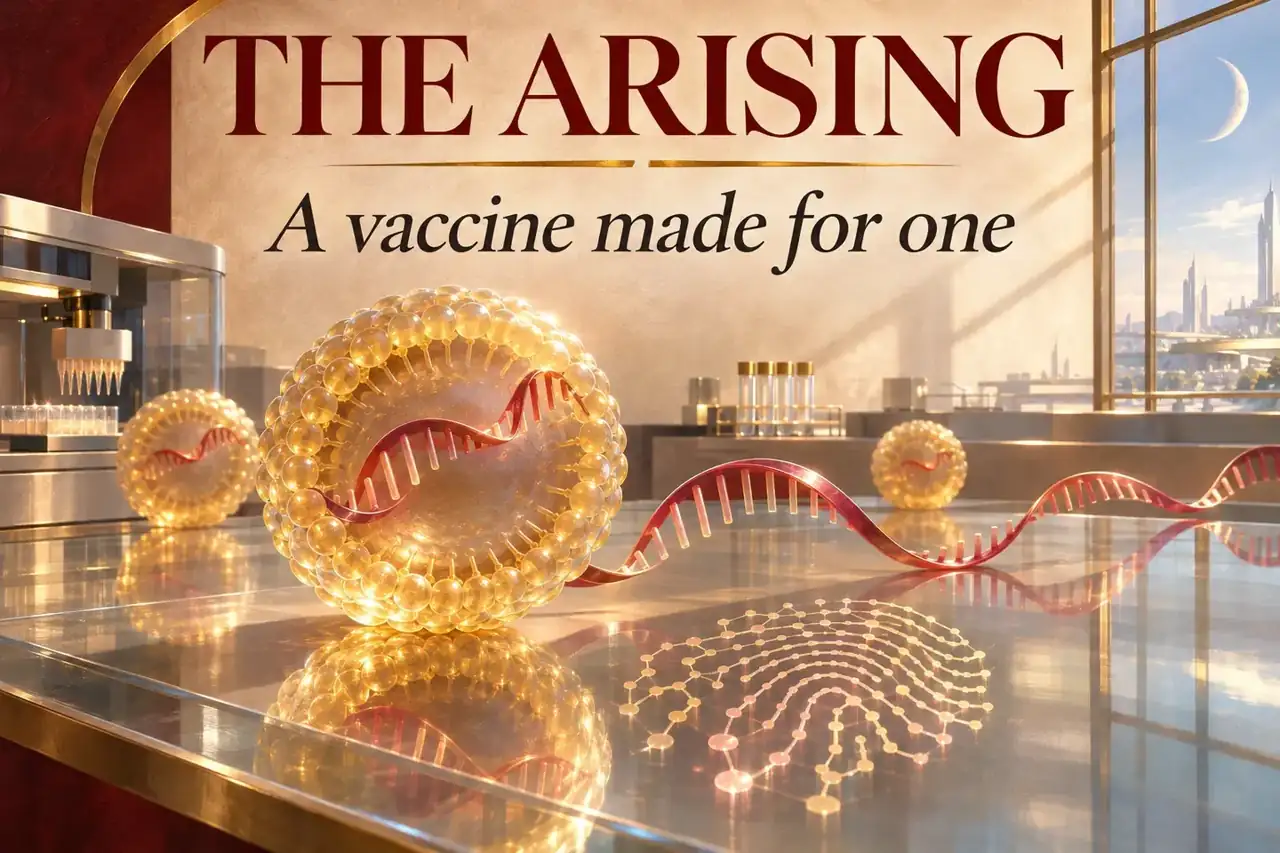
A vaccine designed from one person’s tumor has helped more patients with high-risk melanoma remain alive without their cancer returning. It is a striking step toward a different kind of medicine: use the cancer’s own identifying features to teach the immune system what to find.
The moment after successful cancer surgery contains two truths. The visible tumor is gone. The future is still uncertain. Treatment given afterward aims to deal with cells that may remain, before they grow into another tumor. That interval is where Moderna and Merck are putting personalized mRNA medicine to work.
And it is where the human stakes become clear. A recurrence-free year can hold work, travel, a child’s graduation, an ordinary dinner that does not revolve around the next treatment. The laboratory’s achievement matters because of the life it might leave room for.
A vaccine made for one
Moderna’s treatment is called intismeran autogene, previously known as V940 or mRNA-4157. Its starting material is information: the genetic differences between a patient’s tumor and healthy tissue.
Some tumor mutations produce distinctive protein fragments called neoantigens. Researchers compare tumor and normal samples, then use computational methods to select up to 34 targets that the immune system may recognize. The resulting mRNA carries instructions for making those targets. Tiny fatty particles deliver the message; the goal is to build a population of T cells that recognizes the cancer.
Pembrolizumab, also called Keytruda, supplies the other half of the strategy. It blocks an inhibitory signal that can restrain T cells. One treatment teaches recognition; the other helps release an immune brake. Moderna describes the process in its account of how the individualized therapy works.
This is vaccination used as cancer treatment after diagnosis. Its targets come from the tumor the person has already developed.
The result that moves the field forward
In INTerpath-001, a randomized, blinded phase 3 trial sponsored by Merck and Moderna, 1,137 people with completely removed stage IIB–IV melanoma received pembrolizumab plus either the personalized vaccine or placebo. At two years, an estimated 82.2% were alive without recurrence in the vaccine group, compared with 70.0% in the comparison group.
That is an absolute difference of about 12 percentage points. Across follow-up, the hazard of recurrence or death was 42% lower with the combination. The results reported for the October ESMO meeting also favored the combination for distant spread or death. Longer follow-up is tracking overall survival, and the vaccine remains investigational.
Treatment has a cost in symptoms and time. Fever, injection-site pain and fatigue were common; the investigators’ research summary reports treatment discontinuation because of adverse events in 17% with the combination and 9% with the comparison treatment. Those burdens belong alongside the gain in recurrence-free time.
The central advance is substantial: a medicine whose sequence changes from patient to patient has produced a favorable result in a large randomized cancer trial. That makes personalization a practical therapeutic approach to develop, with a measurable clinical outcome to build on.
What Moderna is testing now
The next question is how far that approach can travel. Moderna and Merck are testing it in several settings, each with its own biology and clinical aim:
- Lung cancer: phase 3 studies cover treatment after surgery, after preoperative treatment leaves residual cancer, and high-risk stage I disease. A separate phase 2 study in metastatic squamous lung cancer combines the vaccine with pembrolizumab and chemotherapy.
- Kidney and bladder cancer: trials are evaluating treatment after surgery for renal cell carcinoma and muscle-invasive bladder cancer. Another phase 2 trial combines it with BCG in non-muscle-invasive bladder cancer.
- Melanoma that has spread: a phase 2 trial asks whether the vaccine can add to pembrolizumab in metastatic disease.
These trials are testing whether the melanoma result can be extended to other situations. They are not additional successful results already in hand.
Moderna is also exploring a different mRNA cancer strategy. In the phase 1/2 Mobilize trial, mRNA-4359 is being studied alone and with pembrolizumab in selected advanced solid tumors. It aims to direct immunity against targets on cancer cells and certain immune cells, rather than making a unique vaccine from each patient’s tumor.
That is the state of the science in useful terms: personalized mRNA has a positive phase 3 melanoma result; several cancer applications are in active testing; other mRNA designs are pursuing different ways to enlist the immune system. A single platform is opening several distinct clinical questions.
The life in the days
A recurrence-free year can make room for work, family, travel and the freedom to make plans. The purpose of better cancer treatment is more life outside treatment.
Explore the public Atlas · The Arising website
A physician-review companion. Source limits travel with the claims. Related links connect ideas and reading, not scientific proof.
If the PDF viewer is unavailable, use the download link above.
Follow the connections
Where this idea leads
Atlas · mRNA medicine platform →
Broader related concept; navigation is not an evidence claim.
November 5, 2026 · mRNA medicines · John Griffin, MD
Three targets. One message.

One experimental mRNA medicine has prompted patients' cells to produce three different cancer-targeting proteins. In an early multiple myeloma trial, four of eleven people whose responses could be assessed had confirmed responses. It is a glimpse of medicine delivered as instructions: give cells a message, and let them make the therapeutic proteins.
For someone whose cancer has returned after several treatments, the practical question is what options remain. A new approach matters when it opens another route to controlling the disease, with enough time and comfort left for living.
Making the medicine inside the body
Moderna's mRNA-2808 carries instructions for three T-cell engagers. These proteins connect immune T cells with targets on myeloma cells: BCMA, GPRC5D and FcRH5. The aim is broader coverage of a cancer whose target expression can vary. This approach makes therapeutic proteins; the personalized cancer vaccines discussed elsewhere in this booklet teach the immune system to recognize tumor features.
The MyEngage study is an open-label phase 1/2 trial. At the June 29 data cutoff, twelve participants had received treatment. Their median age was 72, and they had received a median of ten previous lines of therapy. All three encoded proteins were detected in blood.
What has happened so far
Among eleven evaluable participants, two had very good partial responses and two had partial responses. All four responses were ongoing at the cutoff, with follow-up across the study ranging from half a month to six and a half months. These early, uncontrolled results establish a signal to follow; the next report needs to show how durable the responses are.
Treatment-related grade 3 or higher adverse events occurred in five of twelve participants, mainly affecting the blood. Five developed mild cytokine release syndrome, an inflammatory reaction to immune activation; each case resolved after treatment with tocilizumab. These effects are part of the treatment's burden, alongside its potential.
The next result to watch
The registry lists the trial as recruiting, with an estimated enrollment of 190 and safety as a primary focus. Moderna plans an updated presentation at the American Society of Hematology meeting on December 12. The questions worth following are specific: how long does control last, which doses work best, and what does treatment ask of the person receiving it?
The human goal is a life with more room in it: a walk that still feels possible, a family visit that can be planned, work or creative effort that can continue. A response on a chart becomes more valuable when it gives someone those possibilities back.
This story adapts The Arising's November 5 article on pages 40–41. Moderna sponsors the study, and its employees are among the authors.
Read the investigators' ASH report · Follow the MyEngage trial · Read Moderna's announcement.
Download this illustrated booklet update.
Go deeper with The Arising: Cancer detection and care · Magazine collection · Public Atlas · Arising Health.