THE ARISING · Longevity & Healthspan · Long reads
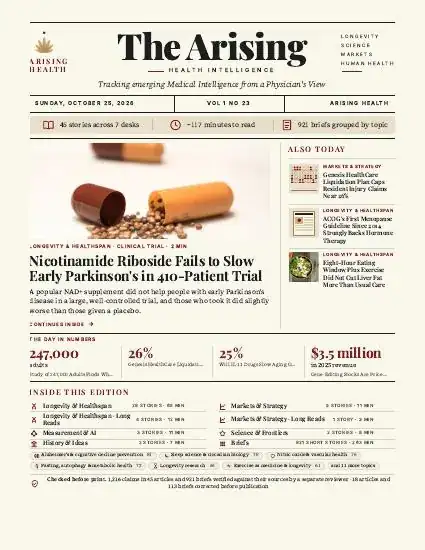
Will IL-11 Drugs Slow Aging Only in People With Scarred Organs? A Testable Idea, Rated 25 Percent
Our research desk proposes that blocking the cytokine IL-11 will move aging markers in older people with fibrosis, not in healthy volunteers. The mouse data are real, but one key premise does not match the paper.
In 2024, mice lacking a single inflammatory signal, interleukin-11, lived about a quarter longer and aged with less frailty. An antibody against the same signal is already in early human trials for lung scarring. The obvious question is who, if anyone, would benefit from it as an aging drug.
Our research desk argues that IL-11 is not a broad driver of age-related inflammation. It sees it as a narrow switch for scar-forming connective tissue, acting through a growth pathway called ERK. If so, blocking it should help only where that scarring program is already running.
The prediction is specific. In people with established fibrosis or metabolic disease, IL-11 blockade should shift epigenetic aging clocks and physical function. In healthy middle-aged volunteers, it should do little. The desk puts 25 percent odds on clocks moving in fibrosis trials and 10 percent on any measurable benefit in healthy volunteers.
The proposed test is inexpensive. Bank blood and cheek-swab samples in an ongoing IL-11 antibody trial for pulmonary fibrosis, then compare clock changes on drug versus placebo.
The mouse study is real and strong for an animal paper. Widjaja and colleagues published it in Nature in 2024, not Nature Aging as our desk wrote. Deleting the IL-11 gene protected mice against metabolic decline, multimorbidity and frailty in old age.
Here is the important correction. The desk built part of its case on the idea that the lifespan benefit was mostly male. The paper reports the opposite. Gene deletion extended life in both sexes, by 24.9 percent on average. An antibody started at 75 weeks of age, roughly late middle age for a mouse, extended median lifespan by 22.5 percent in males and 25 percent in females.
That late-start antibody result matters more than the knockout. It shows the benefit does not require removing IL-11 from conception, which answers one of the desk's own worries. The authors also confirm that anti-IL-11 therapy is in early clinical trials for fibrotic lung disease. We could not independently confirm which company runs which trial.
The desk's comparison with tocilizumab, an IL-6 blocker, claims it lowers CRP in healthy older adults without changing outcomes. We found no trial supporting that statement and treat it as unverified.
Fibrosis is a quiet thread through aging: stiff hearts, scarred livers, thickened lungs and kidneys. A drug that slows it in people who already have it would be valuable even if it does nothing for the healthy.
The desk's larger point holds up well. Aging drugs may work best in the people who are furthest along a specific damage pathway. That logic argues for enrolling by biology, not just by birthday.
• The male-only premise is wrong; the mouse benefit appeared in both sexes. • No human data yet show IL-11 blockade changes any aging marker. • IL-11 may mark activated scar tissue without driving it; other signals such as TGFbeta could be doing the work. • Epigenetic clocks are surrogate measures; a clock shift is not proof of longer or healthier life.
• There is nothing to take. Anti-IL-11 antibodies are investigational and available only in trials.
• If you have pulmonary fibrosis, liver scarring or kidney disease, ask your specialist whether a trial fits you. • Treat the drivers of fibrosis you can control now: blood pressure, blood sugar, excess liver fat and alcohol.
• Whether fibrosis trials of anti-IL-11 antibodies add epigenetic clock or frailty measures. • Safety data from those trials, since IL-11 also plays roles in blood cell production and repair. • Any independent replication of the mouse lifespan result in another lab.