THE ARISING · Longevity & Healthspan
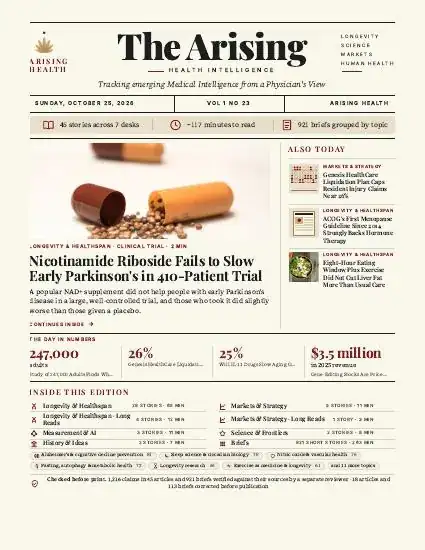
Nicotinamide Riboside Fails to Slow Early Parkinson's in 410-Patient Trial
A popular NAD+ supplement did not help people with early Parkinson's disease in a large, well-controlled trial, and those who took it did slightly worse than those given a placebo.
The evidence is a randomized, double-blind, placebo-controlled phase 3 trial, the NOPARK study, published in JAMA in 2026. It ran at 11 centers in Norway. Of 537 people screened, 410 were randomized, and 393 were included in the main analysis.
Participants were aged 35 or older and had been diagnosed with Parkinson's within the previous two years. Their disease was early stage, and brain scans had confirmed loss of dopamine-producing nerve connections. Half took 500 mg of nicotinamide riboside twice daily for 52 weeks, and half took a matching placebo. Nicotinamide riboside is a building block the body can use to make NAD, a molecule involved in cell energy. Earlier lab and early human studies had suggested it might slow the disease.
The main measure was the MDS-UPDRS, a 0 to 236 scale of Parkinson's symptoms. Higher scores mean more severe disease. At 52 weeks, scores rose by 2.45 points with nicotinamide riboside and fell by 0.27 points with placebo. The adjusted difference was 2.72 points favoring placebo (95% CI, 0.47 to 4.98; P = .02).
That gap is small. The study defines a worsening of 5.2 points as clinically important, and 2.72 is below that line. Still, the authors conclude that the supplement did not improve outcomes and was associated with worse ones.
Researchers also tracked five key secondary measures. Four showed no significant difference. These included the three parts of the symptom scale and the dopamine brain imaging. The exception was non-motor symptoms, such as those covered by the Non-Motor Symptoms Scale. They worsened more with nicotinamide riboside, by an adjusted 4.22 points (95% CI, 1.07 to 7.37; P = .009).
Serious adverse events occurred in 17 of 205 people on the supplement (8.3%) and 29 of 205 on placebo (14.1%). Medical Daily reports that this difference was not statistically significant.
For anyone buying NAD+ products, the key question is whether a higher NAD level means a protected brain. According to Medical Daily's coverage, the supplement did raise NAD in the blood, so it was absorbed. The same coverage says brain scans in a subset of patients showed no significant difference in the brain's NAD-to-ATP ratio. The measurable change in blood did not appear to carry through to a clinical benefit in the brain.
The trial has limits. It studied one dose, in one disease, for one year, and in people already on stable Parkinson's treatment. It cannot say whether NAD-boosting helps in other conditions. Medical Daily notes that the researchers say their findings do not rule out benefits in other diseases. Study director Charalampos Tzoulis said, "Our results therefore do not support NR as a treatment to slow Parkinson's disease," as quoted by Medical Daily.
The coverage also describes the trial as the strongest type of evidence for testing a treatment.
What to watch next
Whether other trials of NAD-raising compounds in different diseases show benefits, and whether the full NOPARK data explain the small worsening.