
A quick, non-invasive test of blood vessel function has been linked to heart risk, so it is fair to ask whether it can also show which stented arteries will narrow again. In a new study of 91 patients, a reading taken before the stent was placed did not independently tell much about how much the artery later narrowed.
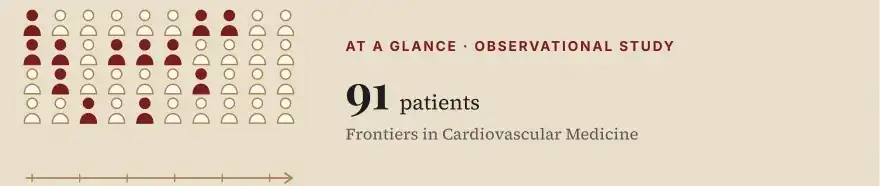
This was a retrospective, observational study in people, published on 27 October 2026 in Frontiers in Cardiovascular Medicine. Researchers at Seoul National University Boramae Medical Center reviewed 132 patients who had the test before a stent procedure between 2009 and 2016. Of these, 91 had follow-up angiography, at a median of 9.4 months. A study like this can show links. It cannot show cause.
The test is called EndoPAT. It measures the reactive hyperemia index, or RHI, a gauge of peripheral microvascular function. According to the paper, RHI reflects nitric-oxide-dependent vessel widening and is a validated stand-in for endothelial function, the health of the vessel lining. The paper also says RHI predicts cardiovascular events.
The outcome was in-stent late lumen loss. That is how much the open channel inside the stent shrank by follow-up, measured by quantitative coronary angiography.
The link was weak. RHI showed only a borderline inverse correlation with late lumen loss (ρ = −0.19, p = 0.07). After adjusting for age, diabetes, hypertension, the number of diseased vessels and the artery's width before the procedure, the association was not significant (adjusted β = −0.11, 95% CI −0.39 to +0.18, p = 0.45). The range of plausible values runs from a small benefit to a small harm. Two further analyses, one handling missing follow-up and one handling several lesions per patient, gave similar results. No correlation survived correction for multiple testing.
One subgroup looked different. Among the 33 patients with small stents (2.75 mm or less), higher RHI went with less narrowing (ρ = −0.375, p = 0.032). In larger stents the correlation was close to zero (ρ = −0.055). But the statistical test for a real difference between the two groups was not significant (p = 0.48). The authors call this signal hypothesis-generating, meaning it is an idea to test and not a finding. This is the weakest part of any reading of the study: a small group, an exploratory split, and a result that did not hold up against chance.
The small-stent group also differed in other ways. It had more diabetes (57.6% versus 27.6%) and worse kidney function. The authors say this points to a higher-risk group, not just a size category. Inflammation did not explain the results. A blood marker of inflammation, hs-CRP, was unrelated to both RHI and late lumen loss. The study has limits. It was retrospective, and 41 of the 132 patients had no follow-up angiography. The subgroup was small, and the procedures were done years ago.
The authors call for prospective studies that separate patients by stent size and pair RHI readings before and after the procedure.
Sources: Frontiers in Cardiovascular Medicine (2026), Frontiers in Cardiovascular Medicine
Keep reading on this subject
Cardiovascular health · Reading the evidence